
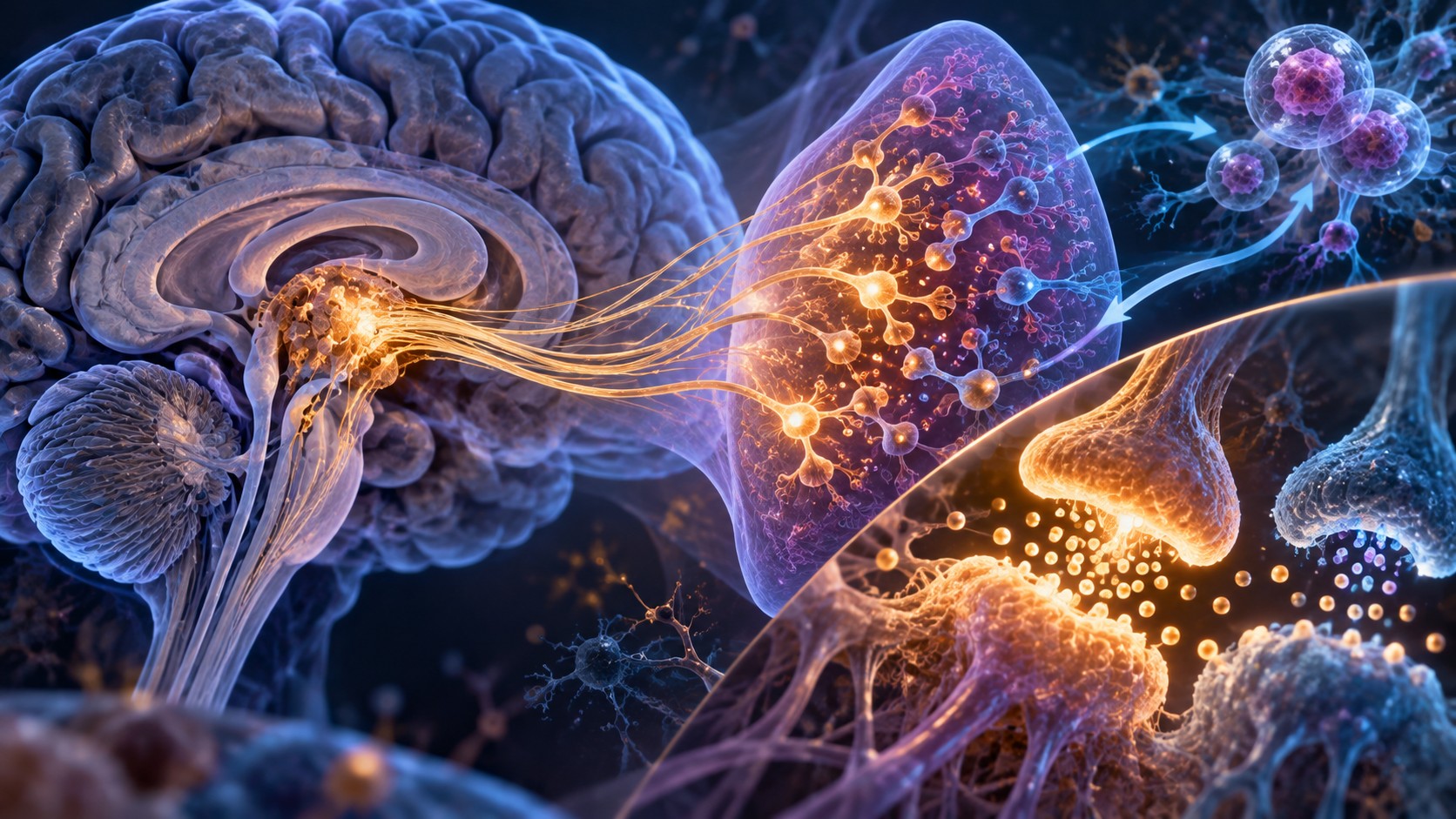
Some neurons have an outsized influence on how the brain controls movement. Dopaminergic neurons are a striking example. Although they represent only a specific population of cells within the nervous system, their gradual loss is closely connected with the motor symptoms associated with Parkinson’s disease.
This relationship explains why these neurons occupy such an important position in cellular research. Rather than treating the brain as a single damaged organ, scientists can examine a particular neural population, understand why it becomes vulnerable and investigate whether its function can be preserved, supported or potentially restored.
The Special Role of Dopamine in Movement
A chemical messenger with a precise function
Dopamine is a neurotransmitter involved in several neurological processes, including movement, motivation and reward. For Parkinson’s Disease research, its role in motor control is particularly important.
Dopaminergic neurons located in the substantia nigra send projections to structures involved in regulating movement. Their signals form part of neural circuits that help determine how easily and accurately movements are initiated.
When these neurons progressively degenerate, dopamine availability within relevant brain circuits decreases. This contributes to difficulties such as slowness of movement, rigidity and resting tremor.
The connection between neuronal loss and declining dopamine signaling gives researchers a relatively defined biological target for cellular investigation.
Why These Neurons Become a Focus for Cell Research
Replacing a missing function
One of the most discussed concepts in Parkinson’s Disease cell therapy research is neuronal replacement. If dopamine-producing neurons are lost, researchers ask whether appropriately developed cells could eventually restore some of the missing signaling capacity.
This is more complicated than simply introducing new cells into the brain. A replacement cell would need to survive, develop the appropriate characteristics, produce dopamine in a controlled manner and establish functional connections with existing neural circuits.
For this reason, scientists are studying how stem cells and progenitor cells can be directed toward specific neuronal identities rather than simply producing large numbers of undifferentiated cells.
The Challenge Goes Beyond Cell Replacement
Surviving neurons also matter
Dopaminergic neurons that remain in the brain are not necessarily healthy. Some may be vulnerable to continued cellular stress even before they are completely lost.
This has led to another important research direction: neuroprotection. Instead of concentrating exclusively on replacing missing neurons, scientists are investigating ways to support the survival and function of cells that are still present.
The two concepts can overlap. A cellular strategy might eventually involve protecting existing neural populations while addressing some of the functions lost through degeneration.
The surrounding environment influences outcomes
Neurons do not operate independently. They interact with glial cells, blood vessels, immune signaling pathways and the extracellular environment. In Parkinson’s disease, changes in these surrounding systems may influence neuronal survival and function.
This makes the biological environment an important part of cell therapy research. Even an appropriately developed replacement cell would need to function within a complex and potentially altered neural landscape.
From Laboratory Models to Clinical Investigation
Cell identity is only the beginning
Modern cellular research places considerable emphasis on producing cells with predictable characteristics. Researchers need to understand their development, behavior, stability and potential risks before clinical use can be considered.
This broader laboratory perspective is reflected in the work of organizations operating at the intersection of clinical medicine and biotechnology. At the Bulgarian STEM PLUS facility, cellular medicine is supported by specialized laboratory capabilities, creating a setting where regenerative approaches can be examined alongside clinical considerations. Its work and areas of focus are presented at stemplus.clinic.
The scientific challenge remains substantial. Researchers must determine not only whether transplanted cells survive, but also whether they integrate appropriately without creating unwanted effects.
Why Dopaminergic Neurons Remain So Important
A clearly defined connection to symptoms
The importance of dopaminergic neurons is partly explained by the unusually direct relationship between their degeneration and the motor features of Parkinson’s Disease. Their role gives researchers a measurable biological problem to investigate.
However, focusing on these neurons does not mean that Parkinson’s disease is simply a dopamine deficiency. The condition involves multiple biological processes, including protein abnormalities, mitochondrial dysfunction, oxidative stress, inflammation and changes in neural connectivity.
A successful cellular strategy would therefore need to account for the wider disease environment.
The next generation of research questions
Current research is moving beyond the basic question of whether new dopamine-producing neurons can be created. Scientists are examining how such cells mature, how they connect with existing circuits, how long they remain functional and whether the surrounding brain environment supports their activity.
These questions help explain why Parkinson’s Disease cell therapy remains an active area of investigation. Dopaminergic neurons provide a logical starting point, but restoring meaningful neurological function requires understanding the entire network in which those cells operate.














Залишити відповідь